Event Top

Demo & Poster

Demo and Poster Session

  • Friday, 20th June11:00-13:00 / 15:00-18:00
  • Industry, Academia, General, Students

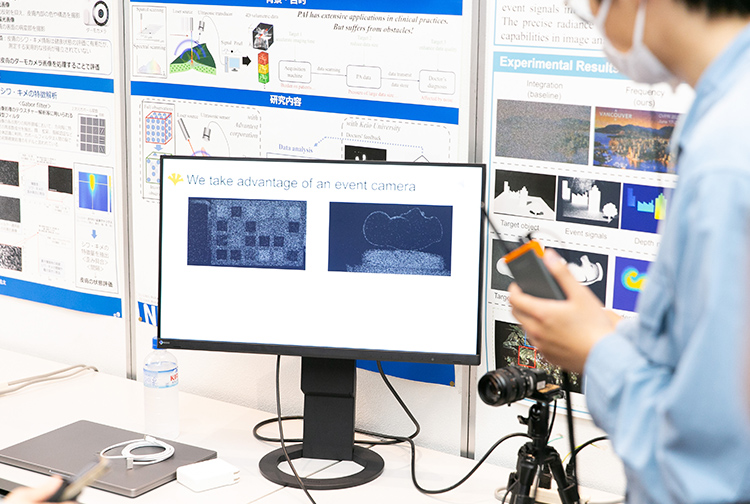
The Demo and Poster Sessions will feature research presentations by researchers and graduate students from the National Institute of Informatics. This year, the medium conference hall on the second floor of the Hitotsubashi Hall will be the real venue, with demos and posters displayed at each of the booths.
During the core time, researchers will be available to explain and ask questions.
*There will be no online broadcast

What is Core Time?

This is a time when you can listen to explanations by the researchers and ask questions directly.

  • [Core Time A]11:10-11:50 / 15:10-15:50 / 17:10-17:50

    *Booth Odd Number

  • [Core Time B]12:10-12:50 / 16:10-16:50/ 17:10-17:50

    *Booth even number

A stamp rally will be held during the demo and poster session!

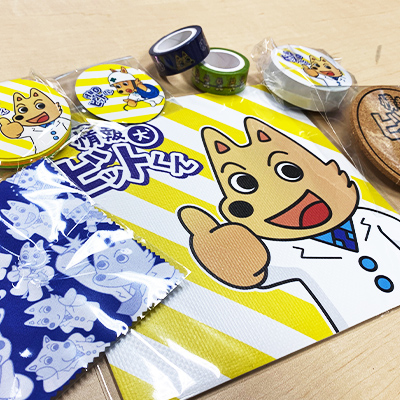
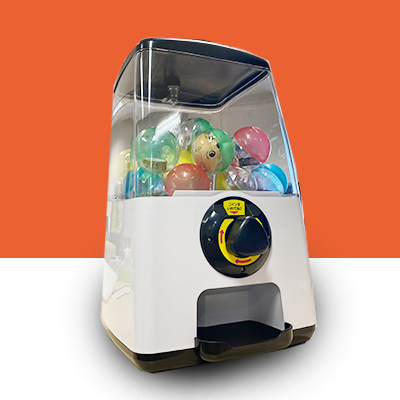
Visit all booths and complete the stamp rally to get coins. Let's play the gakacha-gacha to get NII original bit-kun goods!

Guided Tours

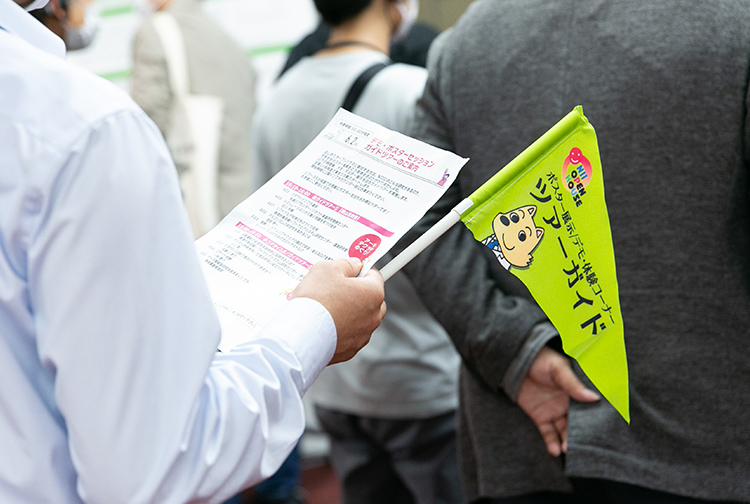
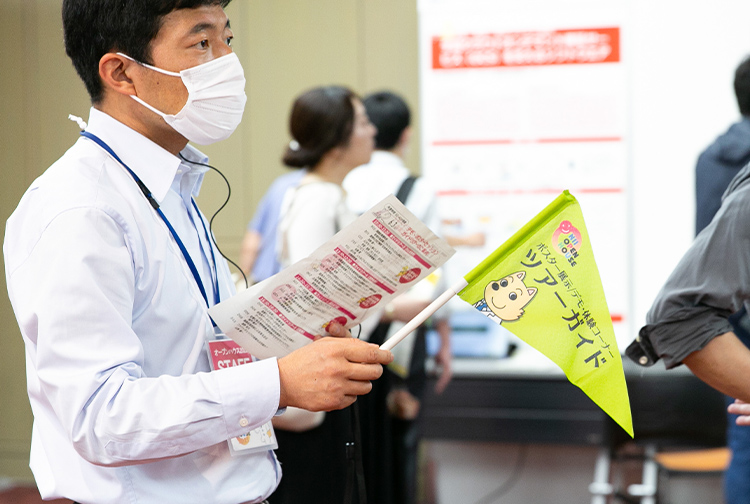
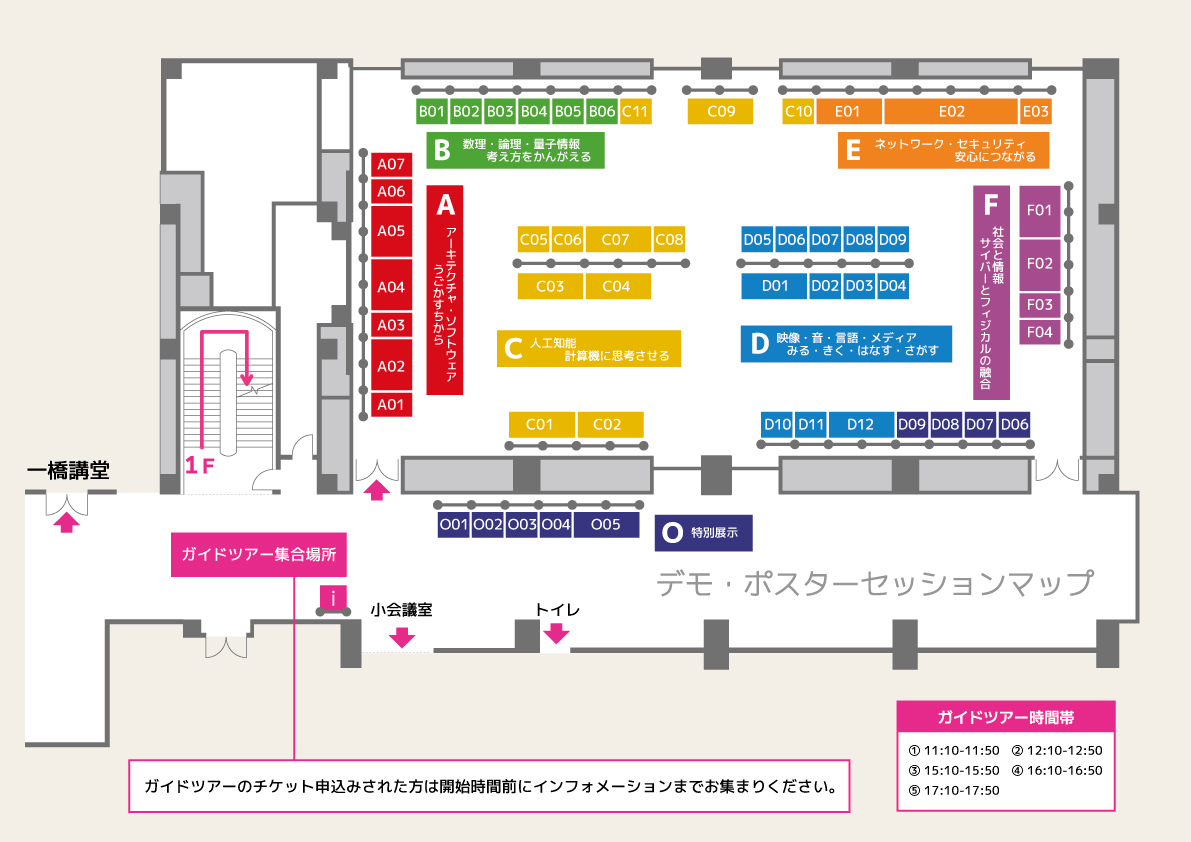
We will hold guided tours in groups, visiting posters by topic. If you wish to join the tour, please gather in front of the information counter at the second-floor main conference hall.
*Please note that, in addition to the Demo & Poster Session ticket, a guide tour ticket for the corresponding time slot is required to participate.

  • Guided tours are available during the following times
  • (1) 11:10-11:50
    Sold out
    [Autonomous Driving Tests, Smart Adjustment of Options, Domestic Medical LLM, Realistic 3D Images, and "Intelligent" Technologies]
    Booths: A-05, B-05, C-03, D-01
  • (2) 12:10-12:50
    Sold out
    [Piano Performance, Anti-Fake Measures, Global Economy, Insect Robots — Explore the Diverse Research of NII]
    Booths: D-08, E-02, F-02, F-04
  • (3) 15:10-15:50
    Sold out
    [From Autonomous Driving to Cyberattack Countermeasures — The Frontlines of Creating “Safety”]
    Booths: A-07, D-07, D-09, E-03
  • (4) 16:10-16:50
    Sold out
    [Cloud Reliability, Software Safety, Quantum Potential, and Medical Support through Image Analysis — The Frontlines of “Supporting” Technologies]
    Booths: A-04, A-06, B-04, C-02
  • (5) 17:10-17:50
    [AI’s Thinking, Trustworthiness, Embodiment, and Applicability — A Multifaceted Overview of AI Research]
    Booths: C-06, C-07, C-09, C-10
  • ※ Session 5 is for participants and prospective students interested in graduate school.

How to Enjoy Demo and Poster Sessions

Venue Map

Demo and Poster Exhibit List

[A] Architecture and Software/How to drive

SINETStream is a software package that supports the development of IoT systems by collecting and analyzing data from various sensors distributed over a wide area. It supports creating secure, highly efficient IoT systems in distributed environments.Presenter : Kumiko Kobayashi, Atsuko Takefusa, Naoya Kitagawa, Ikki Fujiwara (National Institute of Informatics)

This study introduces a system that uses the Virtual Cloud Provider (VCP) to unify and simplify access to computing resources across both cloud and on-premises environments. By using templates, users can easily build, reproduce, and update application execution environments. Use cases include educational exercise systems such as MCJ-CloudHub, as well as the construction and operation of HPC clusters (supercomputers).Presenter : Kazuichi Oe, Tomoya Tanjo, Yuko Tsutsui, Atsuko Takefusa

We are developing “CoursewareHub,” which adds educational features to the programming execution environment JupyterHub for use as a lecture and exercise environment. Jupyter is software that is increasingly being used in actual lectures, and although there are free environments available, there are needs such as integration with LMSs such as Moodle and the ability to build different environments for each course. In this poster, we will demonstrate how CoursewareHub can be customized and utilized to suit educators' needs, including examples of its application.Presenter : Advanced ICT Center / Center for Cloud Research and Development

We operate a private bare-metal cloud using OpenStack as an internal research resource. Operating a cloud infrastructure where various software components work together requires a wide range of expertise, making it essential to form cross-functional teams that transcend the boundaries between development and operations. To address this, we have adopted LC4RI (Literate Computing for Reproducible Infrastructure), which involves developing, testing, building, and operating systems based on “evidence notebooks”—execution records and notes. In this poster, we will introduce the relationship between infrastructure team formation and LC4RI in the context of operations.Presenter : Advanced ICT Center / Center for Cloud Research and Development

AI systems based on deep learning technologies and autonomous driving systems, both with high complexity and uncertainty, are increasingly being deployed. This poster introduces research on testing and debugging techniques aimed at ensuring and improving the safety and quality of such systems. In particular, we will show cases of automated test generation and automated AI model repair based on search and optimization approaches given criteria for "good tests" and "good fixes."Presenter : Fuyuki Ishikawa

We propose a novel quantitative measure for analyzing the behavior of software under uncertainty, grounded in the theory of optimal transport. Our primary contribution is the development of a new verification algorithm, derived by extending the Sinkhorn algorithm—a widely used and efficient approximation method for optimal transport.Presenter : Noboru Isobe (RIKEN)

We introduce our methodology to provide strong mathematical safety guarantees to automated driving vehicles. Building on the existing methodology called “Responsibility-Sensitive Safety (RSS)” for mathematical proofs of automated driving safety, our research established its extension called “Goal-Aware RSS (GA-RSS)” that expands RSS’s application domain to a variety of real-world driving scenarios. The techniques in GA-RSS derived from theoretical results in formal logic enable one to provide mathematical safety proofs to more complex driving scenarios than before, especially those which require achievement of certain goals such as an emergency stop.Presenter : Ichiro Hasuo

[B] Mathematics,Logic,Quantum information/Think the frame of thinking

Category theory is an abstract language of modern mathematics. Its application in Informatics, however, has been mostly as an "abstract theoretical backend"; its direct benefits in concrete and practical terms have rarely been manifest. We present our recent work in which we derive a fast model checking algorithm from a categorical metatheory. The model checking algorithm, which automatically proves properties of probabilistic systems, features the so-called compositionality property that reduces the computational cost by algebraic means. It achieves x100-1000 speedup compared to the state-of-the-art algorithms for some benchmarks.Presenter : Ichiro Hasuo

Computer networks and the Internet marked a revolution for information processing, significantly improving the capabilities and broadening the applications of computers, by allowing different and possibly distant machines to cooperate.Similarly, as quantum processors are starting to become a reality, an interconnection of these devices is expected to enhance their power and anticipate their use to solve classically intractable tasks.This work seeks to contribute to this development by calculating costs and finding protocols to efficiently apply general transformations of quantum systems in distributed scenarios.Presenter : Thales Gottardello Marrafon

We explain "Super Minimal Linear Algebra with Mr. Ryoshika" as an example of the multifaceted use of online teaching materials of quantum technology.It was created with the aim of providing a fun and light way to learn the minimum knowledge of linear algebra necessary for learning quantum information processing, and to further expand the scope of quantum technology.Presenter : Kohei Kobayashi

Physical simulation is an essential technique for reproducing various phenomena on computers. In this presentation, we introduce a method for accelerating simulations of light propagation using fault-tolerant quantum computers. We expect practical applications in a wide range of fields from healthcare to aerospace engineering.Presenter : Asuka Igarashi

In society, people often need to make their own choices about resources or tasks, each having different preferences and constraints. This study explores how a mediator can collect information from individuals and propose recommendations to improve overall efficiency. In particular, we focus on situations where many people choosing the same option reduces the benefit for each individual (e.g., overcrowding at hospitals), and we analyze how well coordination can work in theory.Presenter : Kaito Fujii

In everyday life, encryption technology is used to protect information—such as when entering a credit card number or sending a password to a bank—so that even if the data is intercepted, it cannot be deciphered. However, we do not truly know whether the encryption methods widely used today are completely secure. The security of encryption relies on the difficulty of certain computational problems. Computational complexity theory is the field of study that investigates the difficulty of such computations.Presenter : Shuichi Hirahara

[C] A.I./Thinking Computers

By bringing together the research capabilities of industry, academia, and government, we aim to build an academic research hub. We will develop an environment conducive to the cultivation of research and development capabilities related to generative AI models, ensure transparency through elucidation of the learning principles of generative AI models, and carry out R&D that contributes to the advancement of generative AI models. Through these initiatives, we contribute to the evolution of AI and, ultimately, the creation of innovative breakthroughs over the long term.Presenter : Yusuke Oda , Liu Chaoran, Kazuma Kobayashi , Hirokazu Kiyomaru , Masaru Isonuma , Takashi Kodama , Kota Nakayama , Liu Qianying, Nguyen Ha-Thanh, Yang Zhishen, Su Myat Noe, Hideyuki Tachibana , Junfeng Jian (NII/LLMC Project Researcher)

Founded in November 2017, Research Center for Medical Bigdata (RCMB) has been working on construction of cloud platform for medical bigdata and studies for medical image analysis using machine learning including artificial intelligence (AI). Here we are going to introduce our latest activities and what the future might hold for the bigdata and AI.Presenter : Kohei Murao, Youichirou Ninomiya

Developing medical large language models (LLMs) tailored to the Japanese healthcare system is highly significant. With support from the Cabinet Office’s Cross-ministerial Strategic Innovation Promotion Program, we have built trustworthy foundational LLMs designed to assist healthcare professionals in clinical practice. In this presentation, we will outline our R&D process and showcase a prototype medical LLM.Presenter : Kazuma Kobayashi, Akiko Aizawa

Our lab focuses on using knowledge graph technologies to support various fields, such as medicine and literature. We also work on evaluating the quality of knowledge graphs themselves, aiming to make them more reliable and trustworthy when used. Presenter : Shixiong Zhao

I will explore discrete and continuous structures involved in machine learning from the perspective of information geometry and introduce a tensor decomposition method as an application.Presenter : Mahito Sugiyama

Large language models have recently demonstrated remarkable performance and applications. However, the structure of their embedding spaces remains unexplored.In this presentation, I focus on the hypothesis that these embedding spaces possess a manifold-like structure, and I examine how this may relate to the hierarchical nature of language.Presenter : Tatsuki Ebisawa

Modern AI systems can make highly accurate predictions and decisions, but sometimes they make mistakes that are hard for humans to understand. To address this challenge, we are exploring ways to give AI a more logical way of “thinking” by bridging machine learning and symbolic reasoning. Our work includes leveraging logical constraints during training, developing neural methods for solving combinatorial optimization problems, and extracting structured semantic representations from relational data.Presenter : Akihiro Takemura, Sota Moriyama, Takeru Isobe

In linguistic research focusing on Japanese sign language and European sign languages, there is a growing interest in approaches that seek to elucidate the meaning and function of mouth movements (mouth actions). In this study, we aim to recognise mouth actions using deep learning techniques, with the goal of achieving a significant advancement in sign language recognition technology.Presenter : Biplav Regmi, Asia Institute of Technology, NII Research Intern

In recent years, the performance of robots has improved remarkably, and we increasingly see them in a variety of everyday situations. In this exhibition, we will introduce the mechanism of robot motion through a drum roll performance by a dual-armed robot.Presenter : Naoto Yamanaka (NII/SOKENDAI)

Modern smart grids demand accurate energy monitoring without overloading smart meters’ bandwidth and computing power. This project presents an AI-powered monitoring approach that drastically reduces communication and computation by using event-driven signal compression and lightweight on-device retrieval. Combined with a meta-learning technique on the server, the system adapts to household usage patterns with minimal supervision. Our evaluation shows that the proposed method achieves over 95% accuracy while reducing data transmission by over 99.9%, making it highly practical for real-world deployment.Presenter : Xiaoyu Wang

The exponential family is the most important family of distributions in information geometry, and within it exist various e-flat submanifolds. In this work, we analytically investigate which of these submanifolds is optimal from the perspective of KL divergence.Presenter : Zhou Derun

[D] Image, Sound, language, Media / See, Hear, Speak, Search

Nowadays we enjoy visual media based on technologies for image acquisition, compression, processing, transmission and displays. Recent researches deal with not only images but also light fields for advanced visual media. We introduce ray space representation of light fields and its various applications. For example, only with a single system of lenses, free viewpoint image reconstruction and scene refocusing with preferable bokeh are achieved. Moreover, acquired 3-D images allow us to observe scenes from arbitrary viewpoints simultaneously for 3-D consistent ambient communications, where dynamic light field reconstruction efficiently works for multi-view 3-D displays.Presenter : Kei Terasawa(NII Special Collaborative Research Student/Tokyo University of Science)

Event cameras offer high temporal resolution and low latency, making them effective for a range of applications. In this work, we explore their use in acquiring physical surface properties under active lighting. A key challenge is the absence of absolute intensity values. To overcome this, we design a custom setup with tailored equipment and temporally encoded lighting. Our method enables robust estimation of both surface normals and spectral reflectance. Results show that event cameras, when combined with designed illumination, can extract meaningful physical information, expanding their utility beyond motion detection and into the domain of material and shape analysis.Presenter : Art Subpaasa

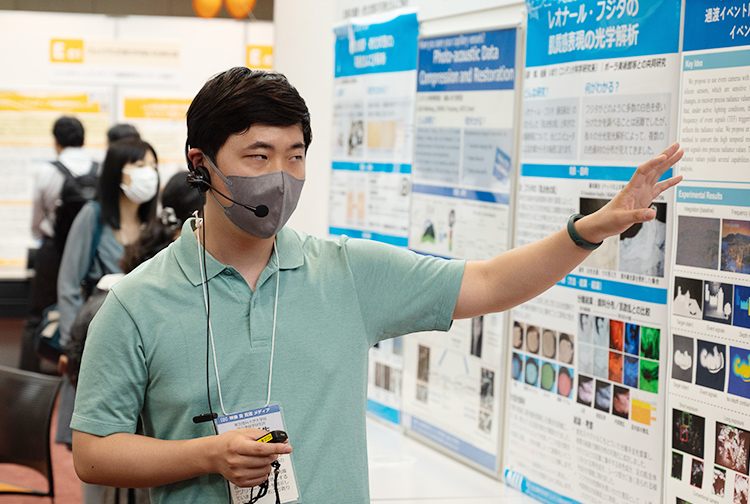
Through light and computer-based analysis, we explore the secret behind the painting technique known as "milky white skin," brought to life by Léonard Foujita (Fujita Tsuguharu). While it had been difficult to determine how Foujita distinguished and applied various shades of white, our spectrofluorescence analysis has revealed the distribution of multiple white pigments.Presenter : Shin Ishihara

The scattering properties of biological tissue vary significantly depending on its health status and the presence of pathological changes.This poster introduces a technique for visualizing and evaluating tissue conditions using microscope images of tissue sections captured under structured illumination.Presenter : Yuta Asano

Noise canceling technology is used in earphones and ducts to cancel out noise using loudspeaker signals. However, when conventional technology is applied in three-dimensional space, the area that can be made quiet is very limited. We are conducting research on spatial active noise control based on the prediction and control of spatial sound to suppress noise over a large area. In this presentation, we will introduce our work on its practical application.Presenter : Denny Hermawanto, Shoichi Koyama

Fact-checking is like being a detective in the world of information, where the goal is to uncover the truth behind the statements or claims we hear and read every day in news articles, speeches, and social media posts. A fact-checker would also look into websites, medical studies, and research to find evidence for claims. Fact-checking is crucial in combating the rise of misinformation. Traditional methods of fact-checking involve human labour to verify claims through extensive research and cross-checking with credible sources, which is not only slow but also requires significant resources. Essentially, fact-checking has four main steps: identify claims, gather evidence, confirm the accuracy of facts, and explain the findings. In our study, we explore Automated Fact-Checking (AFC) through the use of Large Language Models (LLMs). We analyze over 17,000 real-world claims from PolitiFact.com, spanning from 2007 to 2024. We collect evidence of real-world claims from various websites. Then, we utilize a systematic approach to classify whether claims are true or false, and we also generate detailed explanations for each classification. We tested large models of 70 billion size to improve the accuracy of fact-checking and the quality of LLM’s explanations. The results show that bigger models performed better than traditional methods, even without training or fine-tuning of models. Additionally, incorporating evidence from various websites into the models improved LLMs accuracy in classifying real-world claims.Presenter : Maab Iffat

Nowadays, due to the burst of generative artificial intelligence, Deepfake voices become increasingly prevalent online, posing risks of misinformation and public confusion. In this poster you can listen and make guesses to both real and AI-generated short audio clips in both English and Japanese, and then see how our under-development deepfake detection system judges the same samples. Our detection system is based on a widely applicable 2B-parameter foundation model trained on 74,000 hours of natural and synthetic speech, including Japanese ones. For those interested, we are also happy to explain the machine learning technologies that power this deepfake detection system. We can also also explain the details of the machine learning technology underneath about deepfake detection and watermarking to those who are interested.Presenter : Xuechen Liu, Wanying Ge

Piano performance is more than playing the correct notes on a score: subtle changes in tempo and dynamics, the delicate color of each tone, and even the acoustics of the performance space combine to move listeners. Conventional AI methods have struggled to reproduce these human-like nuances under varied musical styles and recording conditions.
We introduce MIDI-VALLE, a next-generation AI piano synthesis system that leverages advanced language-modeling techniques. Although language models were originally developed to generate natural text, MIDI-VALLE treats both MIDI data and audio as “tokens” and learns from a wide range of styles and environments. As a result, it can generalize across genres—from classical to pop—and recreate expressive, lifelike performances even in unfamiliar acoustic settings.
In this poster, we will demonstrate how MIDI-VALLE applies language modeling to capture and reproduce the expressive qualities of human piano playing. Through audio examples, you will hear how the system preserves nuance—phrasing, dynamics, ambience—and opens new possibilities for AI-generated music. Presenter : Zhe Zhang, Yigitcan Oezer

The remarkable advancement of generative AI has increased the risk of misinformation spreading. Deepfakes are a type of misinformation that uses generative AI to artificially create content, such as videos or images, by replacing the faces of individuals with those of others, thereby causing harm such as the spread of false information. In this presentation, we will demonstrate how our developed deepfake detection system, SYNTHETIQ VISION, can identify deepfake videos as counterfeit. By leveraging SYNTHETIQ VISION's detection capabilities, which are capable of handling the latest generative AI technology, we invite you to experience the first step toward a future where we can address misinformation even in a society where AI has become widespread.Presenter : Yusuke Yasuda, Yoshihiko Furuhashi

NTCIR (NII Testbeds and Community for Information access Research)is a series of evaluation workshops of information access technologies including information retrieval, question answering, text generation, inference from text, etc.). It has worked together with more than 100 research groups from all over the world.Presenter : Noriko Kando, Makoto P. Kato

Search models based on large language models (vector search techniques) have been shown to outperform traditional search methods, and their adoption in real-world services is progressing. On the other hand, various issues have been revealed, such as cases where performance decreases compared to conventional technologies, unexpected behaviors occur, and certain search results are unintentionally favored. This poster introduces such "weaknesses" of vector search techniques.Presenter : Makoto P. Kato

Researchers of informatics need large scale data such as text, speech and video generated from sensors, social media, etc. We promote the shared use of such data by means of mediating between industrial bodies and researchers to stimulate research, deepen technology, and create communities. The posters will present the Center’s overview, summaries of the datasets provided through the “Informatics Research Data Repository (IDR)”, and some examples of the research using the datasets.Presenter : Tomoko Ohsuga

[E] Network Security/For our safe lives

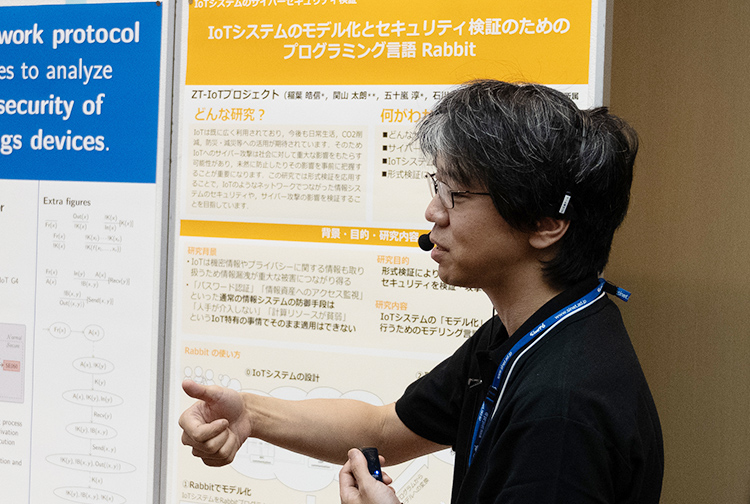
This project aims to realize secure Internet of Things (IoT) systems in accordance with the concept of zero trust by the fusion of formal verification and system software technologies.In this poster presentation, we introduce the ZT-OTA software update framework and a software assurance service for reliability and resilience of IoT software.Presenter : Nobuo Aoki (SOKENDAI), Naoki Yamashita, Kento Aida, Atsuko Takefusa

The Global Research Center for Synthetic Media (SynMedia Center) conducts research and development across various modalities to generate synthetic media, detect fake media, ensure media reliability, and support decision-making. The SynMedia Center will present its latest research findings in a poster presentation with demonstrations.Presenter : Isao Echizen, Syokan Sai, Yuchen Guo

In areas that have a significant impact on our lives, such as critical infrastructure, resilience is essential to maintain the minimum necessary functions and continue operations even if the processing capacity of information systems is reduced due to cyber-attacks. In the healthcare sector, the safety of patients is a top priority, and medical services must be maintained even in the event of a total shutdown of the healthcare system. Our research group aims to realise an infrastructure operation support system that ensures resilience under an Iberian attack in order to ensure resilience in the medical sector.Presenter : Masahito Kumazaki, Hirokazu Hasegawa

[F] Society and Information / Integration of the Cyber and Physical Worlds

The ROIS-DS Center for Open Data in Humanities has been working on a project to explore Japanese culture and history using the latest digital technologies such as AI. This presentation will focus on results related to historical big data and the application of AI to historical Japanese, as well as the results of the “Research and Development Promotion Project for DX in the Humanities and Social Sciences” (DiHuCo), initiated last year by the Ministry of Education, Culture, Sports, Science and Technology.Presenter : Asanobu Kitamoto, Tomoko Yamamoto

This project analyzes equity links among firms and states as a complex network, revealing the hidden architecture and influence of global capital. An AI-powered digital twin-trained on human-mobility data and financial time-series-then generates realistic flows of people and markets. By replaying these dynamics, the twin rapidly simulates how the world economy would react to policy changes or external shocks, enabling early detection of systemic risks and offering actionable insights for more sustainable global economic governance.Presenter : Takayuki Mizuno

By using autonomous synchronization mechanisms in biological systems, it is possible to adapt measurement timings in sensor networks so that it can reduce the impact of measurement errors and improve temporal resolution in sensing.Presenter : Ichiro Satoh, Takashi Ikegami

How does an insect with small nerves reach its destination? In this study, we use airflow visualization and insect VR to investigate how the insect uses its body to deal with odors, and what behavioral changes it causes based on the odor information it obtains.Presenter : Shunsuke Shigaki, Ryoko Sekikawa (RA, NII)

[O] Introduction of NII's service and overview

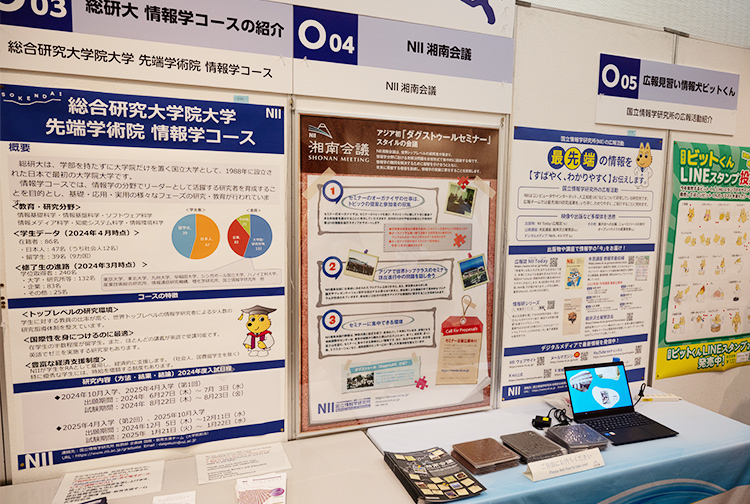
To introduce Informatics Program, Graduate Institute for Advanced Studies, SOKENDAI, which is founded at the National Institute of Informatics.Presenter : International Affairs and Education Support Team

The NII Shanan Meeting is a series of informatics seminars, managed by NII, following the style of the well-known Dagstuhl Seminars. Itaims to resolve various challenges in the field of informatics by providing another world's premier venue for world-class scientists.Presenter : The Office of the NII Shonan Meeting

The Japanese-French Laboratory for Informatics is an International Research Laboratory (IRL 3527) between two French institutions (CNRS and Sorbonne University) and three Japanese institutions (NII, University of Tokyo and Keio University). It was first created on January 1st, 2009 as an International Associated Laboratory, and became a Joint International Unit ("UMI" in CNRS terminology) with the same partners on January 1st, 2012. On the basis of existing scientific cooperation between Japan and France, 4 topics were selected for their potential for fruitful collaborative research: Quantum Computing, Artificial Intelligence, Networks and Cybersecurity and Foundations of Informatics.Presenter : Florian Boudin, Kandaraj Piamrat, Megumi Kaneko, Philippe Codognet

TopSE is an educational program for professional software engineers, reaching its 20th class in the fiscal year 2025. It offers a year-long course that trains software solution engineers to skillfully combine advanced software engineering AI techniques for creating value for businesses, organizations, and society.Presenter : Fuyuki Ishikawa

We will introduce the activities of our lovely mascot NII-Johoken Bit-kun!Presenter : Johoken TeraG

Leveraging the SINET network’s ultra-high speed, high reliability, and multifunctionality, NII provides an authentication federation platform, cloud adoption and utilization support, and academic content platforms as well as develops the NII Research Data Cloud to promote open science. Through those services, NII is working to maintain and provide the Scientific Research Digital Platform. Presenter : Hikaru Matsumura, Tetsuro Shimoda, Yutaka Hayashi, Masayoshi Gohara

The NII Research Data Cloud (NII RDC) is an information infrastructure system that consists of three infrastructures that match the lifecycle of research data: management infrastructure (GakuNin RDM), publication infrastructure (WEKO3), and search infrastructure (CiNii Research). NII RDC is a research data infrastructure system that supports open science and research fairness and promotes data-driven research.Presenter : Yusuke Komiyama(NII),and other members of the Open Science Infrastructure Center (NII)

Proper research data management (RDM) and compliance with rules are essential to ensure the reliability of research. In this presentation, we will present how data governance function supports RDM through functions like policy setting and validation of data management status.Presenter : Research Center for Open Science and Data Platform / Toshiyuki Hiraki

We are entering a new era where AI and big data are transforming the way research is done.At the heart of this change is ‘data.’ To make discoveries, we need an ecosystem system that allows data to be safely collected, organized and shared openly with people worldwide.In this project, we work with universities and research institutions to build the foundation for future research.Would you like to look closely at research and the invisible systems that support it?Presenter : NAKANO Keiichi (NII RCOS)